


Original price was: $325.00.$62.00Current price is: $62.00.
There are a great many PTSD sufferers, and there is a desperate need for rapid and effective ways of working with them. Most current treatment approaches are simplistic and grossly ineffective. When I asked an Iraq vet I worked with recently about her previous 5 years of treatment, she said:
I think I saw 8 or 9 different shrinks, and all they wanted to do was give me meds, and then they had all these stupid things they wanted to do, like a tapping thing where you thought about the war and they did this tapping thing, and that was supposed to make it lessen.
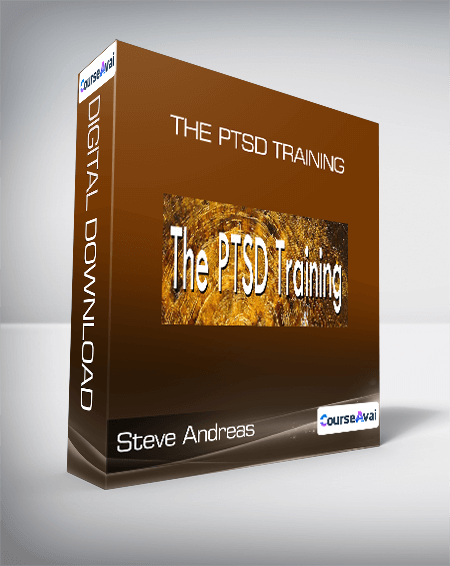
You are currently accessing the institutional-grade blueprint for <b>Steve Andreas – The PTSD Training</b>. Instant digital deployment and lifetime encrypted access are guaranteed immediately upon transaction clearance.
There are a great many PTSD sufferers, and there is a desperate need for rapid and effective ways of working with them. Most current treatment approaches are simplistic and grossly ineffective. When I asked an Iraq vet I worked with recently about her previous 5 years of treatment, she said:
I think I saw 8 or 9 different shrinks, and all they wanted to do was give me meds, and then they had all these stupid things they wanted to do, like a tapping thing where you thought about the war and they did this tapping thing, and that was supposed to make it lessen.
Purchase Steve Andreas – The PTSD Training courses at here with PRICE $325 $62
DOWNLOAD INSTANTLY
PLEASE CHECK ALL CONTENTS OF THE COURSE BELOW!
 Steve Andreas – The PTSD Training

There are a great many PTSD sufferers, and there is a desperate need for rapid and effective ways of working with them. Most current treatment approaches are simplistic and grossly ineffective. When I asked an Iraq vet I worked with recently about her previous 5 years of treatment, she said:
I think I saw 8 or 9 different shrinks, and all they wanted to do was give me meds, and then they had all these stupid things they wanted to do, like a tapping thing where you thought about the war and they did this tapping thing, and that was supposed to make it lessen. And they had this finger thing, follow the finger while you thought about the bad — it was stupid! That didn’t do anything; it just kind of pissed me off — and then off to the next shrink. That was a waste of my time. . . . I like having tools (that I taught her) now because they didn’t give you any of this when we came back. . . Now I have a way to cope with everything—something to do at least to make it better.
The term PTSD is sometimes applied very loosely to any unpleasant memory of an event that continues to trouble someone. Having a deprived childhood, repeated failure in school or business, or being dumped by a lover may be very unpleasant, but it is not usually a life-threatening event. The DSM 5 criteria for PTSD are fairly specific: an exposure to a terrifying life-threatening event, followed by multiple symptoms that persist and don’t resolve over time. (For more detailed diagnostic criteria, see the section at the end of this article.)
Bill was driving the lead Humvee in a convoy in Iraq when an IED exploded by the roadside, killing several men in the vehicle. Ever since this, Bill has had trouble sleeping because of nightmares reliving the explosion, and frequent daytime flashbacks whenever he hears a loud noise. Since then he has been isolated, drinking too much, feeling depressed, and sometimes exploding into rage.
Get Steve Andreas – The PTSD Training download
Bill’s experience satisfies all the DSM 5 criteria for PTSD: The core of PTSD is essentially a phobic response to the terrifying event itself, and can usually be successfully treated using the NLP phobia cure, in which Bill can learn how to view the event as if he were an uninvolved bystander seeing himself going through it from the outside. This is the core of PTSD, and for some sufferers, that’s all there is. The description of John, in chapter 7 of Heart of the Mind, (pp. 61-63) is an example. One session with the phobia cure resolved all his symptoms.
However, there may be many other aspects that contribute to PTSD, and these are often confused with the core phobic response, even by “experts” in the field. These additional aspects are very different from the core phobic response, and each requires a different intervention to achieve resolution. Some of these are closely associated with the incident itself, while others occur before or after the traumatic event. Let’s explore Bill’s experience further to illustrate these additional aspects.
Aspects closely associated in time.
Bill knew that a pop bottle at the side of the road could be a marker for an IED, but he chose to ignore it, so he feels regret for not stopping, and constantly berates himself for his poor judgment, and feels guilty for the deaths that resulted. Bill’s best buddy was killed in the Humvee explosion, and Bill is grieving this loss. In the frenzy of the attack that followed, Bill shot at anything that moved, including two women and several children, and he feels great shame about killing them.
Aspects that developed afterward.
Bill’s lower legs were severely damaged in the explosion, and had to be amputated, so Bill is also grieving this loss of many different treasured sports and activities. In addition he has Traumatic Brain Injury (TBI), and he is depressed by the formidable task of adapting to these disabilities. He was engaged to a woman with whom he was intensely involved. When she found out about his injuries, she dropped him like a hot rock, and it was as if a part of him died, depriving him of love and support when he needed it most. This is when he started drinking too much, and his rages became worse and more frequent.
Aspects that developed beforehand.
Long before Bill joined the army, he suffered repeated verbal (and some physical) abuse from his father, and he internalized this voice, which constantly criticized him no matter what he did. Bill had spent almost a year in the red zone, under constant threat of attack 24/7. The constant anxiety had already made him habitually hypervigilant, sleeping poorly, and reacting instantly to any surprise by becoming fully alert and ready to respond with violence. Bill entered the army as an idealistic gung-ho warrior, but he had already become disillusioned by the gritty reality of war, and had decided that it was a tragic and futile waste, making his burdens utterly meaningless.
Regret, grief, guilt, shame, physical disability, loneliness, insomnia, rages, drug use, self-criticism, depression, generalized anxiety, hypervigilance, violence, disillusion — all of these (and more) may be part of what is often called PTSD. Each of these tends to make the other aspects worse, in a “perfect storm” that often seems to the sufferer to be part of one confusing and tangled ball of chaos and emotional instability. This training teaches how to separate these different aspects and how work with each using different processes that are appropriate for working successfully with each.
Summary of diagnostic criteria for the DSM 5 identify the trigger to PTSD as exposure to actual or threatened death, serious injury or sexual violation. The exposure must result from one or more of the following scenarios, in which the individual:
- directly experiences the traumatic event;
- witnesses the traumatic event in person;
- learns that the traumatic event occurred to a close family member or close friend (with the actual or threatened death being either violent or accidental); or
- experiences first-hand repeated or extreme exposure to aversive details of the traumatic event (not through media, pictures, television or movies unless work-related).
DSM-5 pays more attention to the behavioral symptoms that accompany PTSD and proposes four distinct diagnostic clusters instead of three. They are described as re-experiencing, avoidance, negative cognitions and mood, and arousal.
Re-experiencing covers spontaneous memories of the traumatic event, recurrent dreams related to it, flashbacks or other intense or prolonged psychological distress.
Avoidance refers to distressing memories, thoughts, feelings or external reminders of the event.
Negative cognitions and mood represents myriad feelings, from a persistent and distorted sense of blame of self or others, to estrangement from others or markedly diminished interest in activities, to an inability to remember key aspects of the event.
Finally, arousal is marked by aggressive, reckless, or self-destructive behavior, sleep disturbances, hypervigilance or related problems. This includes the “fight” aspect associated with PTSD as well as the “flight” aspect.
Get Steve Andreas – The PTSD Training download
Purchase Steve Andreas – The PTSD Training courses at here with PRICE $325 $62
Trading foreign exchange, cryptocurrencies, and algorithmic assets on margin carries a high level of risk and may not be suitable for all investors. Past performance of any trading system or quantitative blueprint does not guarantee future results.<br><br><b>Asset Classification:</b>
Related products

Hypnosis and NLP
Biology and Human Behavior, The Neurological Origins of Individuality, 2nd Edition – Robert Sapolsky

Hypnosis and NLP

Hypnosis and NLP
Hypnosis and NLP

Hypnosis and NLP
Dynamic Power Of Deliberate Creation (2006) – Robert Anthony
Hypnosis and NLP

Hypnosis and NLP